
You’ve been told it’s stress. You’ve been told it’s your diet. You’ve been told your period is “just irregular sometimes” and that the hair on your chin is something you should manage, not investigate.
But somewhere inside, you’ve known: something isn’t right.
If that resonates — you’re not imagining things. And you’re not alone.
Polycystic ovary syndrome (PCOS) affects between 6 and 13% of women of reproductive age worldwide, according to the World Health Organization — making it one of the most common hormonal conditions on the planet. And yet, up to 70% of those who have it have never received a diagnosis. Research published in the Journal of Clinical Endocrinology & Metabolism found that nearly half of women with PCOS saw three or more doctors over the span of two years before getting answers.
Two years. Three doctors. And still waiting.
This article exists because you deserve clarity — not another dismissal.
What PCOS Actually Is (Without the Jargon)
PCOS is a hormonal imbalance — specifically, an excess of androgens (often called “male hormones”) that disrupts how the ovaries function. This imbalance creates a ripple effect across your body: how you ovulate, how your skin behaves, how your weight responds to food and exercise, even how you feel emotionally.
The name itself is a little misleading. “Polycystic” suggests your ovaries are covered in cysts — but many women with PCOS have no ovarian cysts at all. The word actually refers to the appearance of immature follicles on the ovaries, and some women never show that on an ultrasound yet still receive — and deserve — a PCOS diagnosis.
This is important. Because the confusion around the name is one of the reasons so many women leave a doctor’s office still without answers.
What Are the First Signs of PCOS? (Early Warning Checklist)
The earliest signs of PCOS often begin in the teenage years, which makes them particularly easy to explain away as “normal puberty.” They are subtle, variable, and — crucially — very easy to normalize.
Here’s what your body may have been trying to tell you:
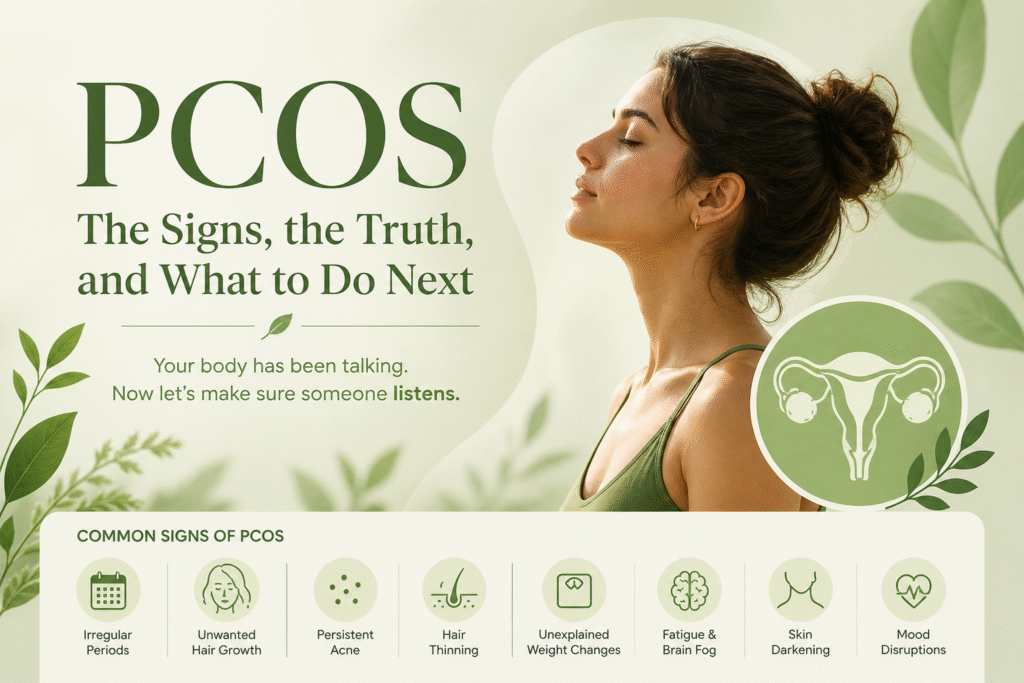
1: Menstrual irregularity — Your cycle is unpredictable. Some months it arrives late; some months it doesn’t come at all. When it does, it may be heavier than expected or last longer than it should. A healthy cycle runs between 21–35 days. If yours is consistently longer than 35 days, or you’re having fewer than eight periods a year, that’s a signal worth investigating.
2: Unwanted hair growth (hirsutism) — Fine hairs appearing along the chin, upper lip, neck, chest, or abdomen. This affects up to 70% of people with PCOS and is directly tied to elevated androgen levels. It is not cosmetic. It is clinical.
3: Persistent, deep acne — Not the occasional breakout. We’re talking about inflamed, painful acne — particularly along the jaw, chin, and chest — that doesn’t respond to typical treatments and doesn’t fade with age.
4: Hair thinning at the scalp — The paradox of PCOS: hair grows where you don’t want it, and thins where you do. This affects roughly 20–30% of people with the condition and often begins subtly, noticed first in the shower or on your hairbrush.
5: Unexplained weight changes — Weight that accumulates — especially around the abdomen — despite no significant changes in diet or lifestyle. Or weight that absolutely refuses to budge no matter how hard you try. This is not willpower. This is insulin resistance, a metabolic condition present in the majority of PCOS cases.
5: Fatigue and brain fog — A persistent, low-level exhaustion that sleep doesn’t fully fix. Difficulty concentrating. A heaviness that most people assume is just “how they are.”
6: Skin darkening — Patches of darker, velvety skin appearing at the back of the neck, underarms, or groin. This is called acanthosis nigricans and is directly linked to insulin resistance.
7: Mood disruptions — Anxiety and depression are not coincidental companions to PCOS. Research shows women with PCOS experience depression and anxiety at rates two to three times higher than the general population. This is biological, not personal failure.
Mild vs. Severe PCOS Symptoms: Understanding the Spectrum
PCOS doesn’t announce itself the same way in every body. For some women, it whispers. For others, it shouts.
Mild presentation might look like slightly irregular periods, occasional acne, and subtle hair changes — easy to attribute to lifestyle or genetics. Many women with mild PCOS go undiagnosed for years because their symptoms feel manageable, not alarming.
Moderate presentation may include more frequent cycle disruptions (fewer than six periods per year), noticeable hirsutism, persistent acne, and difficulty maintaining weight. This is where most women begin seeking answers — and too often get redirected back to “eat better, stress less.”
Severe presentation can involve complete cessation of periods (amenorrhea), significant weight gain, visible scalp hair loss, chronic fatigue, insulin resistance markers, and compounding mental health impacts. Women at this stage are often finally taken seriously — but they should have been heard years earlier.
The severity of your symptoms is not a measure of how “real” your PCOS is. A woman with mild symptoms still deserves diagnosis and care.
How PCOS Is Diagnosed: What Actually Happens
There is no single test that confirms PCOS. Diagnosis is built on a picture — your history, your symptoms, lab results, and imaging — evaluated against criteria known as the Rotterdam criteria.
Under this framework, a diagnosis of PCOS requires at least two of the following three:
- Irregular or absent ovulation — reflected in irregular or missed periods
- Clinical or biochemical signs of excess androgens — such as hirsutism, persistent acne, hair thinning, or elevated testosterone on blood tests
- Polycystic ovarian morphology — multiple small follicles visible on a pelvic ultrasound
Your doctor may also order:
- A full hormone panel (LH, FSH, testosterone, DHEA-S, prolactin, thyroid)
- Fasting glucose and insulin levels to assess insulin resistance
- A pelvic ultrasound to examine ovarian structure
Importantly: you do not need cysts on your ovaries to be diagnosed. You do not need to be overweight. And you do not need to be trying to get pregnant. PCOS exists regardless of your body size, your relationship status, or your fertility goals.
“What They Told Me” vs. What Was Actually Happening
This is the part no other PCOS article talks about — and it matters.
| What you were told | What your body was actually signaling |
|---|---|
| “Your period is just irregular, it happens.” | Possible anovulation — ovaries not releasing eggs consistently |
| “It’s just hormonal acne, it’ll pass.” | Elevated androgens causing chronic, treatment-resistant breakouts |
| “Try losing some weight first.” | Insulin resistance making weight management physiologically harder |
| “A little chin hair is normal.” | Androgen excess requiring hormonal evaluation |
| “You’re just anxious.” | PCOS-driven hormonal dysregulation affecting mood and mental health |
| “Come back if it gets worse.” | A delay in diagnosis that averages over two years |
If this table feels familiar — you weren’t imagining things. The research is unambiguous: providers’ dismissal of symptoms is a documented, studied, measurable problem. Your frustration is not a personality trait. It is a rational response to being failed by a system that should have helped sooner.
When Should You See a Doctor?
You should seek evaluation if any one of the following applies to you:
- Your menstrual cycle is consistently longer than 35 days, or you’re missing periods
- You’re experiencing hair growth in unexpected areas (face, chest, abdomen)
- You have persistent acne that doesn’t respond to standard treatment
- You’re noticing thinning hair at the scalp
- You’ve gained weight without explanation, or cannot lose weight despite effort
- You feel constantly fatigued, even after adequate sleep
- You’ve noticed patches of dark, velvety skin
- You’re struggling emotionally and nothing seems to explain it
You do not need to wait until symptoms become severe. You do not need to present with every symptom. You do not need to already have a theory — that’s what the evaluation is for.
What to say at your appointment: Be direct and specific. Bring a list of your symptoms, how long they’ve been present, and any family history of hormonal conditions. If you feel dismissed, ask explicitly: “Given these symptoms, can we rule out a hormonal imbalance, specifically PCOS?”
You are allowed to advocate for yourself. In fact, research shows that self-advocacy is one of the most significant predictors of eventually receiving a correct diagnosis.
The Bottom Line
PCOS is common. It is complex. And it is profoundly underdiagnosed — not because it’s difficult to identify, but because its symptoms have been normalized, minimized, and mislabeled for generations.
Your irregular periods were not laziness. Your acne was not diet. Your fatigue was not weakness. Your weight was not willpower.
Your body was sending signals. And now — finally — you have the language to make sure someone listens.
This content is for informational and educational purposes only and is not a substitute for professional medical advice, diagnosis, or treatment. If you suspect you may have PCOS, please consult a qualified healthcare provider.