
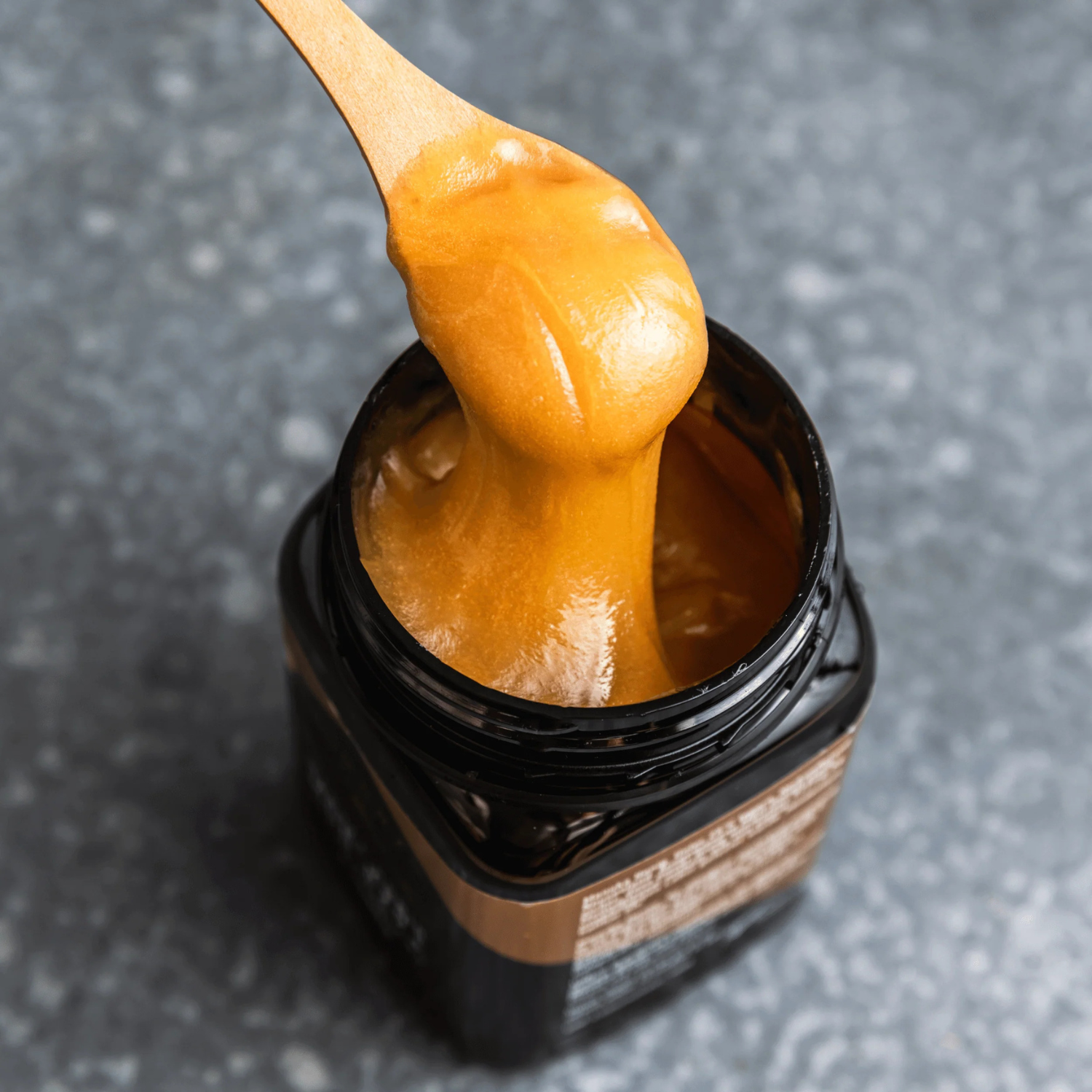
The most counterfeited honey in the world — which is exactly why the paperwork matters
Manuka only comes from one place: the wild hillsides of New Zealand, where the Manuka bush flowers for a few short weeks a year. Nowhere else on earth produces it — not Pakistan, not anywhere in the region.
That single fact is also why it’s one of the most faked honeys sold globally. A jar can say “Manuka” on the label and contain almost none of it. So before we talk about anything else — taste, benefits, ritual — we want to talk about the one thing that actually protects you: the number on the jar.
UMF and MGO — the two numbers that tell you it’s real
- UMF™ (Unique Manuka Factor) — an independent New Zealand certification testing four separate markers, including one that exists only in genuine Manuka nectar. This is the gold standard.
- MGO (Methylglyoxal) — the specific antibacterial compound Manuka is known for. Higher number = more concentrated.
If a jar has neither number — or only a vague word like “active” — that’s the sign to walk away, not the sign of a deal.
| UMF Grade | Approx. MGO | Typical use |
|---|---|---|
| UMF 5–10+ | 83–263+ | Daily wellness, everyday sweetener |
| UMF 15+ | 514+ | Regular use, noticeably stronger |
| UMF 20+ and above | 829+ | Targeted, intensive use — smaller daily amount |
What’s actually known about it
Manuka honey has been studied for over three decades — more extensively than most honey varieties. The research is genuinely solid on a few points: it shows measurable antibacterial activity, it’s rich in antioxidants, and its potency scales directly with its MGO/UMF grade rather than being a vague marketing claim.
What it isn’t: a medicine, a guaranteed cure, or a substitute for treatment of an actual infection or wound. Traditionally, it’s used as a daily wellness addition — a spoonful in the morning, in tea, or as part of a skincare routine — and that’s the honest, evidence-supported use case.
How people use it
- ½ to 1 teaspoon daily, straight off the spoon or in warm (not boiling) water
- Stirred into tea as a wellness-focused sweetener
- Higher UMF grades are typically used in smaller amounts, not larger ones
Storage
Room temperature, below 20°C, away from direct sunlight, lid sealed. Properly stored Manuka has a notably long shelf life — crystallization is normal and doesn’t affect quality; a warm water bath softens it back.
A note on safety
Not suitable for children under one year old. If you’re using it for a specific health concern rather than general wellness, that’s worth a conversation with your doctor first.
FAQs
What is a fair Manuka honey price in Pakistan?
Because it’s imported and independently certified, Manuka honey in Pakistan generally sits well above local honey pricing — the exact figure depends entirely on the UMF/MGO grade. As a rule: the higher the grade number, the higher the price, and that’s expected, not a red flag. What is a red flag is a high-grade claim at a low-grade price.
What are the real Manuka honey benefits?
Well-documented ones include antibacterial activity (tested and quantified via MGO), antioxidant content, and traditional wellness use for immunity and digestion support. It is not a verified treatment for any diagnosed medical condition — treat it as a wellness addition, not a prescription.
How do I know if Manuka honey is genuine in Pakistan?
Check for a UMF or MGO number on the label, ideally with a batch number or QR code linking to lab certification. Since Pakistan doesn’t produce Manuka itself, every genuine jar here is an import — be wary of “made in Pakistan” Manuka claims.
Is a higher UMF or MGO number always better?
Better for potency, not necessarily better for you. Lower grades (UMF 5–10+) suit everyday use; higher grades (UMF 20+) are typically used in smaller amounts for targeted, short-term wellness needs rather than daily habit.
Why is Manuka honey so much more expensive than local honey?
It’s harvested from a single wild bush species that only grows in New Zealand, flowers for a few weeks a year, and every batch must pass independent laboratory certification before it can carry a UMF or MGO rating. Local honey has none of those constraints — hence the price gap.
Can I use Manuka honey the same way as regular honey?
Yes — tea, toast, straight off the spoon — but given the price difference, most people reserve it for daily wellness use rather than everyday cooking, where a more affordable honey does the job just as well.
Reviews
There are no reviews yet.