Most women arrive at a PCOS diagnosis carrying the same quiet, exhausting fear: Is this going to be my life forever?
The search for a PCOS cure is one of the most emotionally loaded health journeys a woman can take. You’ve probably Googled “how to cure PCOS permanently” at 2 a.m. more than once. You’ve read the same recycled lists. You’ve felt hopeful, then defeated, then hopeful again.
Here’s what almost no one tells you: the women who manage PCOS best aren’t the ones who fight their bodies the hardest. They’re the ones who learn to listen to it.
That shift in perspective — from war to conversation — is where effective PCOS treatment actually begins.
First, the Honest Truth About a “Permanent Cure”
Let’s dismantle the myth before it costs you more time and emotional energy.
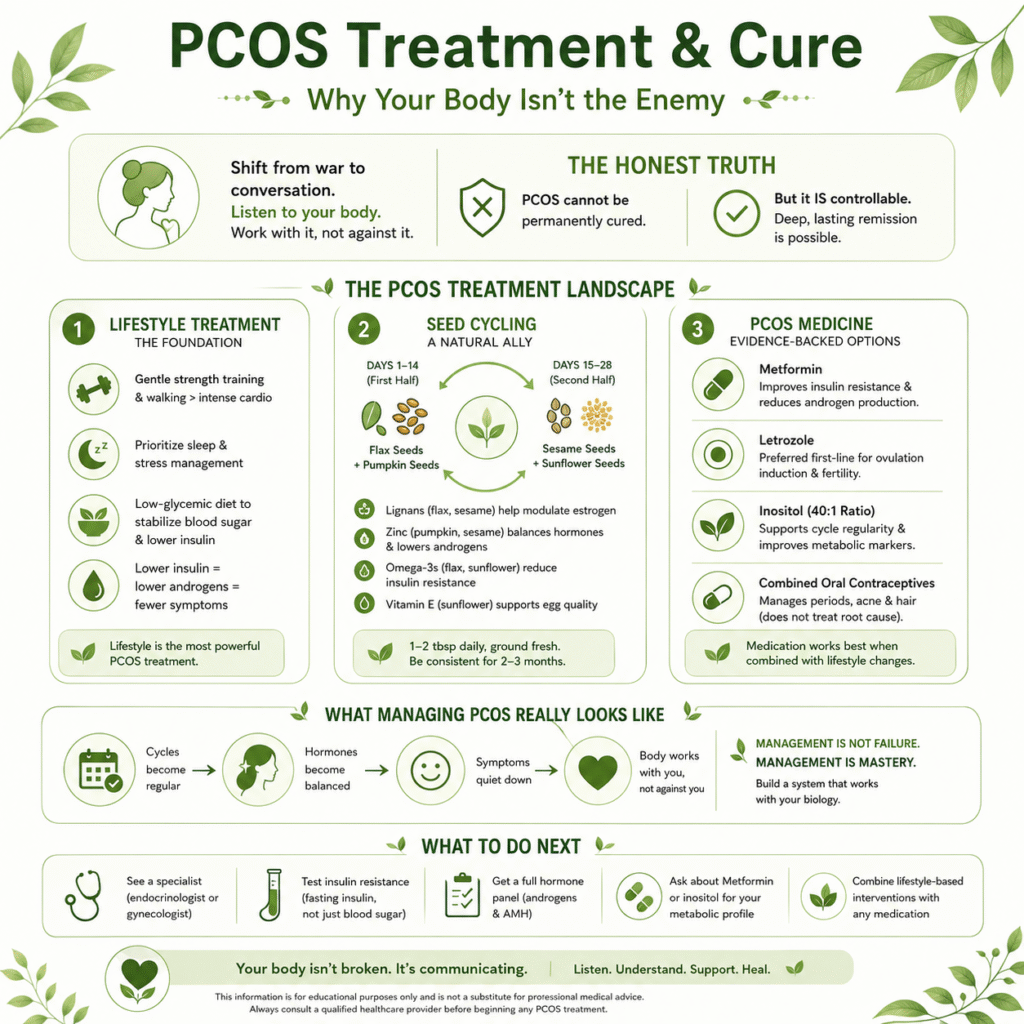
PCOS cannot be permanently cured. This is the medical consensus, confirmed by the NHS, the World Health Organization, and leading endocrinologists worldwide.
But here’s the part that gets buried: not curable does not mean not controllable. These are two radically different realities.
PCOS is a hormonal and metabolic condition. Clinical treatment focuses on individualized approaches targeting specific symptoms — because PCOS expresses itself differently in every woman. For some, the dominant struggle is irregular cycles. For others, it’s insulin resistance, weight, fertility, or skin. Your PCOS is not the same as anyone else’s PCOS.
What “permanent cure” seekers are actually looking for — and what’s genuinely achievable — is deep, lasting remission. Cycles that return. Hormones that stabilize. Symptoms that quiet down. That is real. That happens. But it requires a multi-layered approach, not a single magic answer.
The PCOS Treatment Landscape: What Science Actually Supports
1. Lifestyle Treatment — The Foundation No Medicine Can Replace
If you could take one thing from this article, let it be this: lifestyle intervention is the most powerful PCOS treatment available, and it’s often the most underestimated.
PCOS today is strongly linked to insulin resistance and metabolic dysfunction. Gentle strength training and walking consistently outperform intense cardio for PCOS management. The reason matters — high-intensity exercise can temporarily spike cortisol, which worsens hormonal disruption in women already running on a stressed endocrine system.
Sleep, stress regulation, and blood sugar stability aren’t “soft” additions to a treatment plan. They are the treatment plan, with medication as support.
A low-glycemic diet that keeps insulin levels steady reduces androgen production at the source — because in PCOS, it’s often high insulin that tells the ovaries to produce excess testosterone. Feed the insulin problem, and you quietly feed every other symptom.
2. Seed Cycling — An Emerging Natural Ally Worth Knowing About
Seed cycling is gaining serious attention in integrative medicine — and for good reason, even as formal clinical trials catch up to the practice.
The approach is simple: eating flax and pumpkin seeds during the first half of your cycle (days 1–14), and switching to sesame and sunflower seeds in the second half (days 15–28).
Why does this matter for PCOS? The lignans in flax and sesame seeds act as phytoestrogens, which may help modulate estrogen levels — particularly helpful in PCOS, where excess androgens disrupt ovulation and lead to irregular cycles.
Zinc in pumpkin and sesame seeds improves progesterone and estrogen balance while lowering androgens. The omega-3 fatty acids in flax and sunflower seeds help reduce insulin resistance. Vitamin E in sunflower seeds supports egg quality.
Is seed cycling a standalone PCOS cure? No. The idea behind seed cycling is that certain seeds contain specific nutrients that support hormone production and metabolism during different cycle phases — making it a supportive tool, not a replacement for medical care. Think of it as sending your hormones a consistent, gentle signal rather than leaving them in static.
How to start: Grind your seeds fresh (a coffee grinder works perfectly). One to two tablespoons per day, mixed into smoothies, oatmeal, or yogurt. Consistency over two to three months is where the real results emerge.
3. PCOS Medicine — A Clear Overview Without the Overwhelm
Medication in PCOS is never one-size-fits-all. Here’s what the evidence says about the most commonly prescribed options:
Metformin
Originally a diabetes medication, Metformin is now a cornerstone of PCOS treatment. Its metabolic action involves improving insulin resistance, which helps resolve hormonal and metabolic disturbances and increases ovulation, pregnancy, and live birth rates compared to placebo. It works at the root — reducing the insulin signals that drive excess androgen production.
Letrozole
Recent evidence, as reflected in the 2023 International Evidence-Based Guideline for PCOS Assessment and Management, supports Letrozole as the preferred first-line agent for ovulation induction due to its superior efficacy in achieving ovulation and live births compared to Clomiphene Citrate. If fertility is your primary goal, this is typically where evidence-backed treatment begins.
Inositol
Inositol is a vitamin-like compound gaining interest as a natural alternative. In PCOS, the body converts myo-inositol to D-chiro-inositol at unusually high rates, depleting myo-inositol levels and disrupting hormonal balance and ovarian function. Supplementing with a 40:1 ratio of myo-inositol to D-chiro-inositol has shown meaningful results for cycle regularity and metabolic markers.
Combined Oral Contraceptives (COCs)
For women not currently trying to conceive, COCs remain a widely used option for managing irregular periods, acne, and excess hair growth — though they manage symptoms without addressing the underlying metabolic picture.
One critical note: without addressing root causes, symptoms often return once medication stops. Modern PCOS care combines medical science with lifestyle medicine. Medication is a powerful lever — but it pulls harder when lifestyle is doing its part too.
What “Managing PCOS” Actually Looks Like in Real Life
Here is the reframe that changes everything for most women:
Management is not failure. Management is mastery.
A woman who has regulated her cycle through diet shifts, consistent seed cycling, and Metformin isn’t “not cured.” She has built a system that works with her biology. Her hormones are no longer chaotic. Her body is no longer working against her.
That is the goal. That is what’s available to you.
The women who struggle most with PCOS are often the ones stuck chasing a cure that doesn’t exist, bypassing the real and meaningful progress that’s genuinely within reach.
What to Do Next
If you’ve been living with PCOS symptoms without a clear treatment direction, the most important step is seeing an endocrinologist or gynecologist who specializes in hormonal health — not a general practitioner who will hand you a birth control prescription and send you home.
Ask specifically about:
- Insulin resistance testing (fasting insulin, not just blood sugar)
- A hormone panel that includes androgens and AMH
- Whether Metformin or inositol is appropriate for your metabolic profile
- Lifestyle-based interventions alongside any medication
Your body isn’t broken. It’s communicating in a language that, once you learn to understand it, becomes something you can genuinely work with.
That’s not a compromise. That’s how healing actually works.
This article is written for informational purposes only and is not a substitute for professional medical advice. Always consult a qualified healthcare provider before beginning any PCOS treatment.
References:
- NHS – Polycystic Ovary Syndrome Treatment (2022)
- WHO – Polycystic Ovary Syndrome Fact Sheet (2025)
- Frontiers in Nutrition – Natural Compounds in PCOS Management (2025)
- PMC – Pharmacological Management of PCOS, Tandfonline (2025)
- SOGC Position Statement – Inositol for PCOS (2025)
- Cardiff University – Treatment Options for Anovulation in PCOS (2025)
- ScienceDirect – Seed Cycling as Integrative Therapy for PCOS (2024)
- Sagepub – Therapeutic Role of Metformin in PCOS (2025)