The Question Nobody Answers Honestly
You searched “PCOS causes” expecting a clean list. Five bullet points. Maybe a diagram of ovaries. What you probably found was a wall of clinical jargon that left you feeling like a malfunctioning machine.
Here’s the perspective shift that most articles never offer you:
Your body is not broken. It is responding — intelligently — to conditions it wasn’t designed to handle.
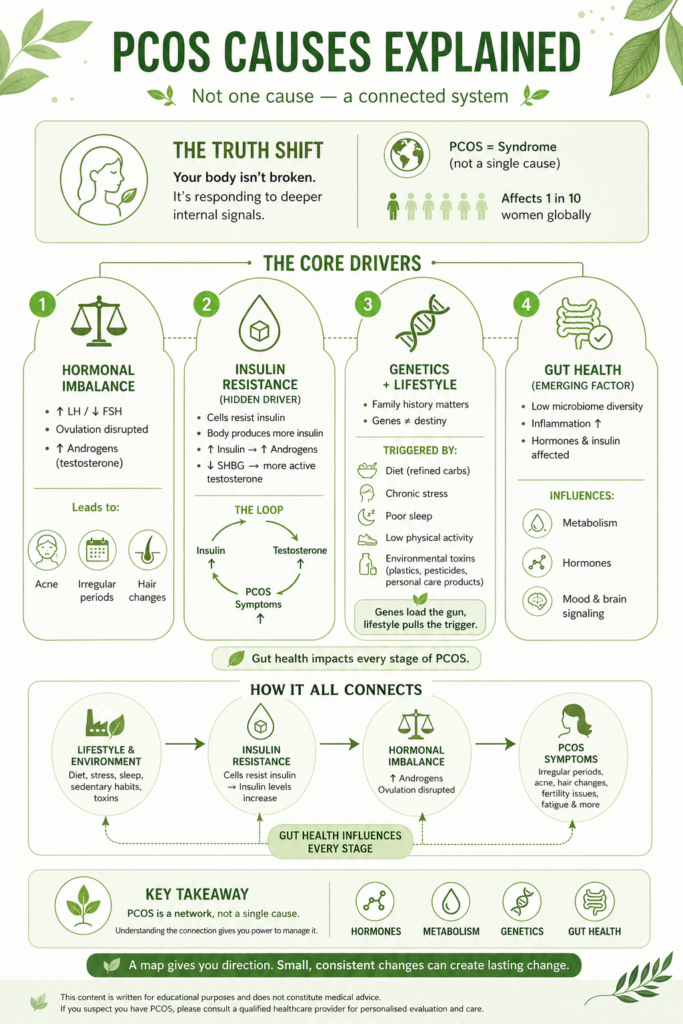
PCOS (Polycystic Ovary Syndrome) affects an estimated 1 in 10 women of reproductive age globally. It is one of the most common hormonal disorders in women. And yet, despite its prevalence, the question of why it happens remains frustratingly open-ended in mainstream medicine. The honest answer is: PCOS has no single cause. It is the visible result of a complex conversation happening between your genes, your hormones, your metabolism, your stress response, and your environment — all at once.
Understanding that conversation is where real clarity begins.
The Hormonal Imbalance at the Center of It All
Every discussion of PCOS causes starts here — and for good reason. At the core of the condition sits a disruption in the body’s hormonal orchestra.
In a typical menstrual cycle, the pituitary gland releases two hormones in a precise ratio: follicle-stimulating hormone (FSH), which nurtures egg development, and luteinising hormone (LH), which triggers ovulation. In women with PCOS, this ratio is frequently skewed — LH levels run disproportionately high while FSH lags behind. The result? Follicles begin to develop but never fully mature. They stall. Over time, they accumulate as small fluid-filled sacs on the ovaries — the “polycystic” in the name.
But the deeper issue isn’t the cysts themselves. It’s what drives that LH surge in the first place: excess androgens.
Androgens — often called “male hormones,” though every woman produces them — are elevated in the majority of people with PCOS. Testosterone, androstenedione, and DHEA-S all tend to run higher than they should. These elevated androgens suppress ovulation, contribute to irregular periods, and produce the outward symptoms many women first notice: acne that doesn’t respond to cleansers, hair thinning at the crown, or unwanted facial hair growth.
The key thing to understand is that this hormonal imbalance is rarely the origin of the problem. More often, it is a downstream effect — a consequence of what is happening deeper in the body’s metabolic and genetic architecture.
Insulin Resistance: The Hidden Driver Most Women Never Hear About
If hormonal imbalance is the face of PCOS, insulin resistance is often the force behind the mask.
Insulin is the hormone your body uses to move glucose (sugar) from your bloodstream into your cells for energy. When cells stop responding to insulin efficiently — a state called insulin resistance — the pancreas compensates by pumping out more and more insulin. Blood insulin levels rise.
Here is where PCOS enters the picture in a way that is profoundly underexplained: excess insulin directly stimulates the ovaries to produce more androgens. It also signals the liver to reduce its production of sex hormone-binding globulin (SHBG) — the protein responsible for keeping testosterone in check. Less SHBG means more free, active testosterone circulating in your bloodstream. More testosterone means suppressed ovulation, more follicle stalling, more of the symptoms you already know.
This insulin-androgen loop is self-reinforcing. Each feeds the other.
Crucially, insulin resistance in PCOS is not simply a consequence of weight. Research consistently shows that lean women with PCOS also experience significant insulin resistance, independent of body mass index. This is why the advice to “just lose weight” misses the biological reality for so many women — the metabolic disruption runs deeper than body size.
What drives insulin resistance? A combination of genetic predisposition, dietary patterns high in refined carbohydrates, sedentary behaviour, chronic stress, sleep disruption, and — increasingly — the state of your gut microbiome.
Genetics vs. Lifestyle: It Is Never One or the Other
One of the most paralyzing questions women with PCOS ask themselves is: Did I cause this?
The answer is nuanced, and it deserves honesty rather than false comfort.
Genetics undeniably plays a role. Twin studies and family analyses confirm that PCOS has a strong hereditary component. If your mother, sister, or aunt has PCOS, your risk is meaningfully higher. Genome-wide association studies have identified several candidate gene variants — particularly those involved in insulin signalling pathways, LH receptor function, and androgen production — that appear more frequently in women with PCOS.
But here is the critical distinction that most genetics-heavy articles overlook: having the genes does not mean PCOS is your destiny.
Contemporary research increasingly describes PCOS through an “evolutionary mismatch” lens. The genetic variants associated with PCOS may have once conferred a survival advantage — efficient fat storage during food scarcity, a delayed reproductive window during harsh conditions. These were features, not flaws, in the environments our ancestors navigated. Placed into the modern world — with its ultra-processed foods, chronic psychological stress, sedentary routines, disrupted sleep, and unprecedented exposure to endocrine-disrupting chemicals (found in plastics, pesticides, and personal care products) — those same ancient survival programmes become mismatched, and PCOS symptoms emerge.
In other words: the genes load the gun. The environment and lifestyle pull the trigger.
This is why lifestyle factors matter so deeply — not as a source of shame, but as a genuine lever of change. Sleep quality, movement, dietary choices, stress management, and reducing chemical exposures are not cosmetic recommendations. They speak directly to the genetic and metabolic pathways driving PCOS.
The Emerging Factor: Your Gut’s Role in PCOS
This is where the science is moving — and where almost no consumer-facing PCOS content has arrived yet.
Emerging research reveals that women with PCOS consistently show a less diverse gut microbiome compared to women without the condition. This gut dysbiosis — an imbalance in the bacterial communities living in the intestines — appears to contribute to PCOS through multiple routes: increased intestinal permeability (sometimes called “leaky gut”), chronic low-grade inflammation, disrupted bile acid metabolism, and altered gut-brain axis signalling that affects appetite, mood, and hormonal regulation.
The implications are significant. Your gut microbiome can influence how your cells respond to insulin, how much inflammation circulates in your body, and even how androgens are metabolised and recycled. When that ecosystem is disrupted — by a low-fibre diet, antibiotic exposure, high stress, or poor sleep — the resulting cascades can amplify every other driver of PCOS.
This does not mean your gut microbiome caused your PCOS. But it does mean that nurturing it could be one of the most overlooked strategies for addressing PCOS from the root.
What This Means for You
PCOS does not have a single cause because it is not a single condition. It is a syndrome — a cluster of metabolic, hormonal, and reproductive disruptions that can look different from one woman to the next.
But understanding the web of causes — the hormonal imbalance driven by androgen excess, the insulin resistance that fuels it, the genetic predisposition shaped by environment, and the gut microbiome that quietly moderates it all — gives you something more valuable than a diagnosis.
It gives you a map.
And a map, unlike a verdict, tells you where to move next.
This content is written for educational purposes and does not constitute medical advice. If you suspect you have PCOS, please consult a qualified healthcare provider for personalised evaluation and care.